Platform
What the VME is
Everything starts from the vessel: hull geometry, powertrain, any technology fitted or proposed. The model is built from first principles, so nothing is borrowed from another ship and the ship need not exist yet. It is run over real or planned voyages across the vessel's life and returns fuel, emissions, regulatory exposure and lifetime cash flow. First answers in weeks, re-runs in hours.
Scenario
- Vessel specificationnewbuild or existing
- Technologiesestablished or entirely novel
- Commercialscapital and operating costs, fuel and carbon price scenarios
- Routes and operationhistorical performance or future scenario
Environment30 years of hindcast met-ocean data
Regulatoryregion, fuel, technology and vessel-accurate impact
Validationin-house developed, industry and academic verified
Commerciallifetime cash flow, NPV and payback
High fidelity simulation of every system, linked, over the vessel's life
Output
- Lifetime economic performance
- Regulatory impact
- Fuel and emissions reporting
- Individual and multi-voyage statistics
- Technology and system performance
- Lifetime digital twin asset
Process
How it works
01
Inputs and scenario
Vessel particulars, engine data, routes, operating profile and any technology fitted or proposed.
02
Geometric modelling
Hull, superstructure, appendages and fitted technology built in 3D, checked against photographs or scans.
03
Holistic CFD
Hull, aero and devices solved together, with the rudder holding course in the solver. Resistance validated to within 5% of tank data and correlated against sea trials.
04
Performance models
Simulation condensed into fast, continuous performance models, each with validity checks.
05
Core engine
The ship is stepped along real routes through 30 years of weather, with the force balance solved at every timestep.
06
Commercial and regulatory engine
ETS, FuelEU, CII and EEXI calculated as the rules are written. Full lifetime cash flow.
07
Outputs and digital twin
Every quantity per timestep, voyage, year and lifetime. The models stay yours.
Difference
What makes it different
Built from the ship's own physics
Every model comes from the vessel's own geometry and routes. Nothing is scaled from a sister ship or a fleet average.
Works on ships that do not exist yet
Results come from geometry rather than in-service data, so newbuilds, novel technologies and stacked combinations can be assessed, with conflicts between measures exposed.
Net saving rather than the quoted figure
Any device fitted changes how the ship behaves. Side force, rudder correction, engine load point and auxiliary draw are all accounted for, and we report the net saving.
Built once, used for the ship's life
The models are kept and re-used. A new rule, fuel price or retrofit candidate re-runs in minutes on the same validated baseline.
A COMPREHENSIVE ECOSYSTEM
What does the VME include?
The VME solves the interactions between complex systems across a lifetime of simulated voyages
Solved as one system
Solved together for your vessel in any scenario under consideration
Add a technology or operating assumption and the propeller sits at a different load point with the emissions and compliance position changing in tandem.
We consider
Scope
What technologies can the VME assess?
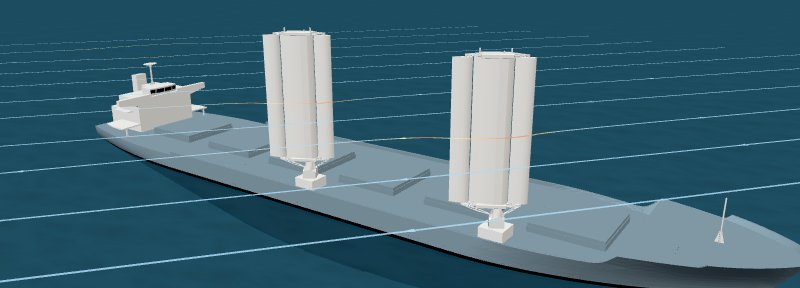
We assess a broad range of technologies, covering wind propulsion, hydrodynamic efficiencies and operational changes.
Because results come from geometry rather than in-service data, a technology does not need a track record on your ship class to be assessed, and combinations can be stacked so conflicts between measures show up before the capital is committed.
Tested against physical evidence
90+
towing tank runs across speeds, leeway and rudder angles
<5%
resistance accuracy against benchmark data
30 yrs
of hindcast weather behind every route
45
vessels modelled
Tell us about your vessels
Describe the decision in front of you and we will say what the VME can answer.